
Trust Intelligence
LiveDTI Engine
Data truth is AI truth. A model or agent is only as true as the records it acts on. We score the record 0 to 100 before anything acts on it, score the agent while it works, and keep the receipt.
The Data Trust Index (DTI) is an eight-dimensional scoring framework, developed by SuperTruth Inc., that scores any record on a 0 to 100 scale; the published weights were calibrated in health. AI is only as trustworthy as the data it learns from. DTI™ solves that. The Data Trust Index™, patented and a trademark of SuperTruth Inc., measures every record across eight weighted dimensions and produces a single 0 to 100 DTI score. Proven in healthcare, it is the scoring layer underneath the entire SuperTruth platform.
8
Trust dimensions
0 to 100
DTI score range
4
Audience weight profiles
5
Products powered by DTI
Intake
Intake: every source verified before anything downstream touches it
A record enters from any format: EHR exports, claims files, lab data, registry data, CSV, HL7, FHIR. The intake step of the pipe maps and classifies every incoming field against your target schema, with human review for the edge cases, and scores each record across the eight dimensions of the Data Trust Index on the way in.
Nothing is copied. The record is verified where it lives, every step is logged, and a record that fails your rules is flagged, quarantined or enriched before it goes any further. It exits with a DTI score and a full provenance chain.
Consent
Consent: verified on every record, not assumed
Consent is one of the eight dimensions, and the consent step is how it is governed. Five additive tiers, so a patient grants exactly what they mean and nothing more: from basic data sharing, to research participation, to commercial use. A patient can grant, modify, pause, resume or revoke at any time.
Revocation propagates downstream the moment it happens, across every connected system. Different rules apply per data origin, so IRB protocols, payer agreements and patient consents coexist in the same pipe without conflict. Every consent event lands in a hash-chained audit log; when the regulator asks, the answer is already documented.
Reservoir
Where scored records land
The record stays where it already lives, in your Databricks, your Snowflake or whatever you run. The reservoir holds its score, its consent state and its provenance, and that is what your models, APIs and analytics read.
Three schemas, RAW, CURATED and RESEARCH, for three levels of confidence; a record promotes as its score earns it. Set a DTI floor and nothing below it reaches a model. Cross-institutional questions run in clean rooms, so partners query across the network without seeing each other's data, and no raw record moves.
Live demo
Five stages. One DTI score. Run on synthetic records, in front of you.
Walk the five stages first: receive, parse, score, seal, deliver. Then run the same pipeline yourself on one of three synthetic patient RECAPs, or a PDF of your own. It runs server-side and nothing you upload is stored.
Record intelligence pipeline, on synthetic records
A record comes in. It gets scored, sealed, and delivered with an audit trail.
This is what a partner's patient records look like inside the SuperTruth pipeline, shown here on synthetic records. Every field extracted, every source scored, every event sealed in an immutable log before the enriched record is returned.
Record received
Transfer log
Storage
Encrypted at rest (AES-256). Scored where your records already live; nothing is copied out. Original PDF is never modified.
Technical architecture
How the pipeline works in production.
The answers to the questions a technical team will ask: how do files come in, how are they stored, how is the score computed, and how does the audit trail hold up under scrutiny.
File ingestion
DTI scoring engine
Audit trail
Delivery
Security and compliance
Integration
Run the pipeline yourself
Three synthetic records, Gold, Silver and Bronze, so you can watch the score move. Synthetic records only: do not upload a document with real patient information.
Try with a synthetic RECAP
Synthetic data only. Do not upload documents containing real patient information.
We also asked a fruit fly's complete nervous system wiring, held fixed, to reproduce this score. Read the connectome study.
Capabilities
What DTI Engine does
One score, not eight metrics
Dimensional scores collapse into a single DTI score. Stakeholders see one number. Engineers see the breakdown. Both are right.
Audience-tuned weight profiles
VA, research, investor, and government profiles weight dimensions differently. The same record can carry different DTI scores for different audiences, because trust is contextual.
Scoring at every stage
DTI runs at intake, at query time, and continuously in the background. A source that degrades over time automatically degrades in DTI score.
Composite ring visualization
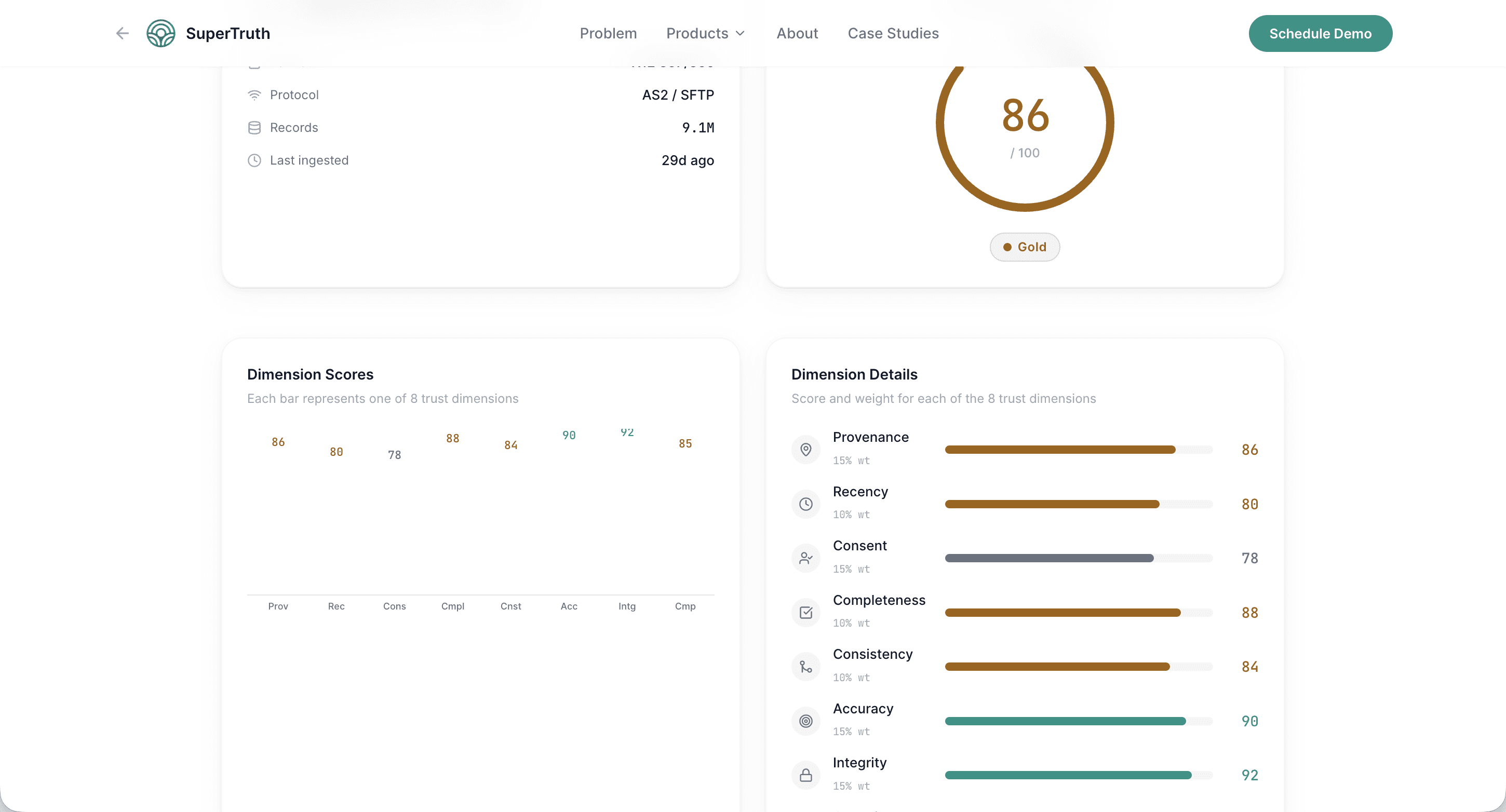
Each of the eight dimensions renders as a segment in the Trust Ring. Spot exactly where quality degrades and which dimension is the failure point.
Cross-source consistency
Flags records that contradict each other across sources before they corrupt downstream analysis. Agreement is a trust signal. Disagreement is a warning.
Compliance inside the score
Consent and Provenance carry the HIPAA and GDPR checks; nothing is bolted on.
How much should you trust this record?
The insight behind the Data Trust Index™ is that data quality is not one thing, and AI quality is not one thing. A record can be complete but stale. It can be recent but unconsented. It can be accurate but non-compliant. AI models trained or fine-tuned on such data inherit every flaw invisibly. Traditional quality tools treat these as separate problems. DTI treats them as dimensions of a single question: how much should you trust this record? Each dimension is independently scored and independently weighted. The weights are configurable by audience and context. A healthcare AI model weighs consent and provenance differently than a financial compliance engine weighing accuracy and regulatory alignment. The result is a score that carries meaning across any sector, any source, any model, and any use case. DTI scores any record; the published weights were calibrated in health.
The Measurement Framework
Eight dimensions. Every record. Every time.
Each dimension is independently scored, independently weighted, and independently auditable. No black boxes.
Provenance
Source pedigree, device attestation, and chain-of-custody. Where did this data come from, and can you prove it?
Measures: CLIA/CAP lab source, device attestation, chain-of-custody documentation
Consent
Explicitness, scope, duration, and revocation hygiene. Was the person asked, and does that consent still hold?
Measures: Consent explicitness, scope match, duration, revocation status
Recency
Time-decay calibrated by modality. A CBC result ages differently than a continuous HRV stream.
Measures: Age relative to modality-specific decay curves, last-updated timestamp
Quality
Resolution, completeness, missingness, and noise floor. How clean and complete is the record itself?
Measures: Field completeness, formatting, noise floor, missingness patterns
Concordance
Corroboration across independent sources. Does the lab result agree with the wearable? Does the EHR match the claim?
Measures: Cross-source agreement (lab, wearable, EHR), temporal consistency
Validation
Clinical linkage to outcomes and peer-reviewed evidence. Is this data type established as clinically meaningful?
Measures: Outcome linkage, peer-review status, clinical evidence grade
Breadth
Dimensional richness across biomarkers, biometrics, and contextual signals. A richer record is a more trustworthy one.
Measures: Biomarker count, biometric coverage, contextual signal richness
Stability
Variance control and test-retest reliability. Does this record produce consistent measurements over time?
Measures: Variance across repeated measurements, test-retest reliability coefficient
The Trust Scale
Every record earns a tier.
The DTI score is not a gradient; it resolves to a tier that carries meaning for every stakeholder in the pipeline.
Platinum
90+
Regulatory-grade. Meets the highest standards across all eight dimensions. Suitable for regulatory submission and clinical decision support.
Gold
80 to 89
Clinical-Grade. Strong across all dimensions. Suitable for clinical research, patient-facing products, and institutional AI models.
Silver
70 to 79
Operational-Grade. Fit for operational analytics and population health. Flag dimensional gaps before clinical use.
Bronze
55 to 69
Exploratory. Useful for discovery and hypothesis generation. Remediation required before operational or clinical deployment.
Fails
< 55
Does not meet minimum trust threshold. Record quarantined pending remediation or rejection.
“The lab industry has never had a trust standard. DTI created one. When we tell a health system our data scores 92, they know exactly what that means: across eight measurable dimensions, not just our word for it. It changed how we price our data services and how imaware positions itself in every partner conversation.”

Brodie Flanders
CEO, imaware
The Engine Underneath
The Data Trust Index™ is the scoring engine every SuperTruth product depends on. The intake step scores every record on the way in. MyBio.Health surfaces the score as the patient-facing trust credential. LEDGER weights lab results by DTI score. VIOLET qualifies behavioral signal against it. The methodology is patented. DTI™ and Data Trust Index are trademarks of SuperTruth Inc.
Who uses it
Built for the organizations that move health data
Health systems scoring incoming data at the point of ingestion
Research organizations enforcing data quality gates before analysis
Payers validating claims and clinical record integrity at scale
Patient-facing platforms displaying DTI scores as earned credentials
What you get
The outcome, not just the capability
- A single DTI score per record, not a dashboard of metrics
- Configurable weights for every audience and use case
- Dimensional breakdown that pinpoints exactly where quality fails
- DTI scoring embedded throughout the entire SuperTruth pipeline
See DTI Engine in action
Schedule a 30-minute walkthrough with the SuperTruth team.