
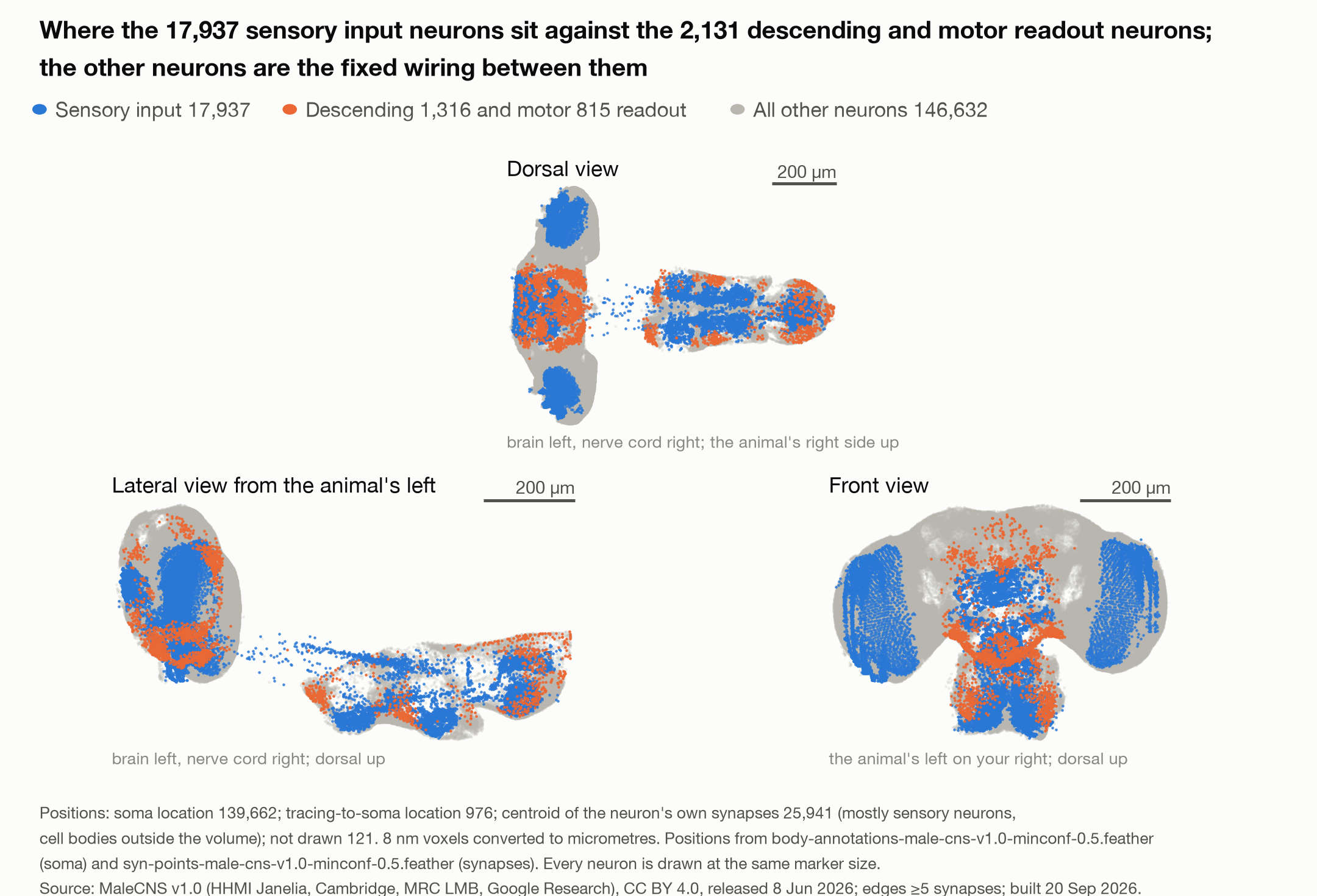
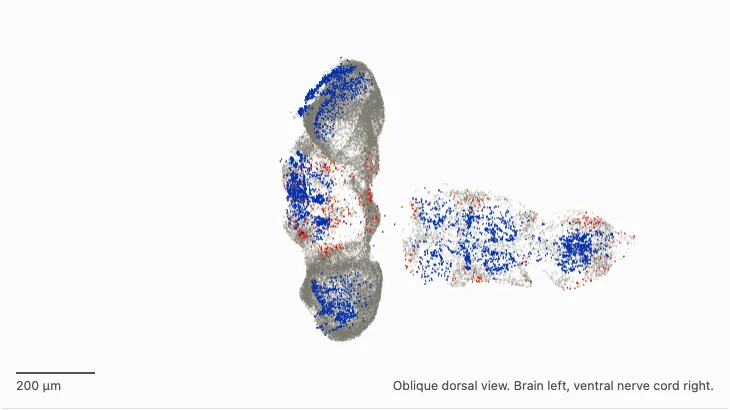
Open the viewer on its own page if it does not load here.
Research
We borrowed a fruit fly's brain to score health data. The whole map is public.
Intelligence is structure, not scale. We borrowed a brain to prove it.
Jason Alan Snyder, Co-Founder, SuperTruth. ORCID 0009-0001-6157-8100. 21 September 2026.
Last updated 21 September 2026.
This is not the fruit fly chess story. That project used a different connectome release and a different task; SuperTruth had no part in it. This page reports SuperTruth's own experiment: the fly's wiring asked to reproduce a health data trust score, with controls.
In 2026, HHMI Janelia, the University of Cambridge, the MRC Laboratory of Molecular Biology and Google Research released the complete wiring diagram of a male fruit fly's central nervous system, free to use under CC BY. It lists 211,577 reconstructed cells; 166,700 of them are classified neurons, and we used every one. Between those neurons the release records 25.6 million connected pairs. We kept the 6,242,118 joined by five or more synapses, the threshold the FlyWire analyses use to separate reliable connections from ones a single misplaced synapse could create, and we moved none of them. Then we asked that wiring to reproduce SuperTruth's Data Trust Index™ (DTI) on synthetic health records. Not one connection in the judge is ours. To our knowledge, as of 21 September 2026, this is the first reported use of a whole central nervous system connectome to score the trustworthiness of health data.
Data Trust Index on this page means SuperTruth's record-level trust score, described in the April 2026 paper linked below; the name is also used elsewhere for unrelated products.
In short: we took MaleCNS v1.0 (the Male Central Nervous System connectome), held its 166,700 neurons and 6,242,118 connections fixed, and trained only the gain on each connection, an input projection and a readout. We asked that wiring to reproduce the Data Trust Index, a 0 to 100 trust score on health records, and VIGIL's Behavioral Integrity Index on agent event logs. On seed 1 of 5 the fly's wiring reproduced the DTI engine to within 1.58 points of composite error with tier agreement 0.880; its degree-preserving shuffle and a random graph of the same density did as well, and all three fixed graphs beat a trained network of the same size. On the same 300 records, four frontier models given the published DTI paper matched the engine's tier on 20% to 45%; the fly, 84%. The yardstick is the set of controls and decision rules we wrote down before the first run. Every figure is provisional: seed 1 of 5, a point with no interval. This page is the plain-English account; the paper carries the protocol, the tables and every run manifest.
Key facts: the fruit fly connectome and the Data Trust Index
| Connectome | MaleCNS v1.0, the complete central nervous system of one adult male fruit fly; released 8 June 2026, CC BY 4.0 |
|---|---|
| Neurons kept | 166,700, every classified neuron |
| Connections kept | 6,242,118 of 25.6 million connected pairs |
| Threshold | five or more synapses per neuron pair |
| Connections moved in training | none |
| Trained | the gain on each connection; an input projection into 17,937 sensory neurons; a readout from 1,316 descending and 815 motor neurons |
| Teachers | SuperTruth's deployed DTI engine (health records, 0 to 100, eight dimensions) and VIGIL's Behavioral Integrity Index scorer (agent event logs) |
| Controls | five: the same wiring shuffled, a random graph at matched density, a network with a matched number of trainable parameters, a linear readout, and four frontier models (Claude Opus 5, GPT-5, Grok 4, Gemini 3 Flash) |
| Records | 20,000 synthetic DTI records (4,001 in the test split; 300 scored by the model arms) and 20,000 synthetic BII event windows (4,000 in the test split) |
| Seeds finished | 1 of 5; every result is provisional |
| First-seed results | What we found, below: the four result sentences and the table of every arm. |
A note from the author
I have been saying for years that the future of intelligence is biological and quantum (Milken Global Conference, May 2025). Electrons alone will only take us so far. The machines we call large language models are marvels, and they are also what I have called kerplinko machines, a phrase borrowed from my friend and mentor John Kheit, after pachinko: drop a token in at the top, let it rattle down through billions of pins, and see where it lands. And the pins were placed by the internet, which rewards what spreads over what is true. A machine that boots from that inherits the bias at the kernel. The fly's wiring was placed by a world that does not care what is popular.
A parent helps the boot sequence. In the beginning you feed the child its core kernel, and only later does it learn and adapt on its own. Harlow showed what happens to infant monkeys raised with nothing to hold: they never recover, however much they learn afterward (Harlow, 1958). The first thing a machine is fed is not one input among many. It is the kernel.
Curation is part of creation. It sets the kernel. Establish a good kernel and the sky is the limit. Very few are bothering with that. We are.
The machines are enormous, hot, and repetitive, running the same colossal computation over and over to produce each word. Set one beside a fruit fly, an animal we swat without a thought, and compare the architecture and the appetite. The fly wins on both. Its brain has 166,700 neurons and runs on almost nothing. No engineer designed it. It was refined over hundreds of millions of years by a process that does not tolerate waste.
There is a warning in that comparison. We should be careful about what we choose to abdicate control to, and I have written about that elsewhere. But it is not the point of this experiment.
The point of this experiment is simpler. The design of nature is not to be diminished, and not to be relegated to a footnote beneath our newest technology. We took a complete nervous system, exactly as nature built it, and asked it to do one of the hardest jobs in health data. What it did and did not do is in the pages that follow. Whatever the number says, the lesson holds. We have much more to learn from nature. In fact, everything.
Jason Alan Snyder, September 2026
Why we did this
The dominant assumption in health AI is that a model's judgment can be trusted because the vendor says so. That is not trust. It is deference. A frontier model is billions of numbers no one has read, trained on text no one has audited, producing a score no one can trace back to a reason. When a hospital asks why a record was rated safe to use, the honest answer is that nobody knows.
The problem is structural. You cannot audit what you cannot see, and every large model is built to be unseen.
A fruit fly's nervous system is the opposite object. In 2026 the complete wiring of one animal's brain and nerve cord became public Berg et al. (2026): every neuron, every connection, each one observed under an electron microscope, typed, and labeled with the chemistry it uses. Nothing in it was trained. Nothing in it was guessed. It is a mind whose every part is a published fact.
So we borrowed it. The release lists 211,577 reconstructed cells; 166,700 of them are classified neurons, and we used every one. Between those neurons it records 25.6 million connected pairs, and we kept the 6,242,118 joined by five or more synapses, the threshold the FlyWire analyses use to separate reliable connections from ones a single misplaced synapse could create. We moved none of them. We trained only how loudly each connection speaks, where a health record enters, and where the score is read out. Then we asked it to do our job: reproduce the Data Trust Index on health records and the Behavioral Integrity Index on agent event logs. And we made it compete: the same wiring shuffled, a random graph of the same density, a conventional network with the same number of trainable parameters, a linear readout, and four frontier models handed our published paper and the same records.
If the fly's wiring does the job, the judge has 6,242,118 connections and every one of them can be looked up. Trust stops being a vendor's claim and becomes a property you can audit.
If evolved wiring beats the same wiring shuffled, structure carries computation on its own. Bigger is not the only direction.
A large model runs the same enormous computation for every token it emits, and it emits hundreds of tokens to score one record. It keeps doing the same thing over and over. A fly's wiring had hundreds of millions of years of selection to stop doing that. Our run is a digital simulation, so we claim nothing about the animal's energy. We count the work instead: about a hundred million multiply-adds per record, and how many neurons fire at each step.
This judge is small, deterministic, runs on a laptop, and has never read the internet. The record does not leave the room, and it cannot have been memorized.
We publish the result either way. We wrote the controls and the decision rules before the first run, and a wiring that fails is a fact worth having.
Models are other people's business. Ours is whether the thing judging your data can itself be judged. Intelligence is structure, not scale. We borrowed a brain to prove it.
Why a brain you can read is a trust judge you can audit
A fruit fly's brain and nerve cord have been mapped completely: every neuron, every connection, published free for anyone to use Berg et al. (2026). It is not software. It is a map made with an electron microscope. Every connection is a physical fact you can look up, with a named cell type and the chemical it uses.
We used every one of its 166,700 classified neurons and kept the 6,242,118 connections joined by five or more synapses, the threshold that screens out connections a single misplaced synapse could create. We moved none of them. We tuned three things only: how loud each connection is, where a health record enters, and where the score comes out. Then we asked the fly's wiring to reproduce our trust scores and compared it with the same wiring shuffled, a random graph of the same density, a same-size conventional network, a linear readout, and four frontier models reading our published paper.
A chatbot is a library with the doors welded shut. The fly brain is a circuit board with every trace labeled and the schematic published.
We are not saying a fly is smarter than a chatbot. We are not treating patients. Every record was synthetic. If the wiring does not matter, Section 4 of the paper says so. To our knowledge, as of 21 September 2026, nobody has asked a trust question of a brain that can be read cover to cover.
What we held fixed in the fly connectome, and what we let move
What stayed fixed
The MaleCNS v1.0 map was released on 8 June 2026 and described in Cell on 3 September 2026. We took its table of which neuron connects to which. We kept every pair joined by five or more synapses. Each connection got a fixed sign, push or pull, from the sending neuron's predicted chemical. That left 166,700 neurons and 6,242,118 connections. Not one of them moved during training.
What we trained
Three things moved and nothing else. The volume on each connection, which is how loudly it speaks. A way in, which writes a record's fields into the 17,937 neurons a fly senses with. And a way out, which reads the score from the 1,316 descending and 815 motor neurons a fly acts with. The wiring decided what could reach what. Training decided how loud.
The teachers
The teacher for the health records was our deployed DTI engine, which scores a record from 0 to 100 across eight dimensions. A second task used VIGIL's Behavioral Integrity Index (BII) on synthetic software-agent event logs, with VIGIL's scorer as the teacher.
The five controls we ran the connectome against
A result with no control is a story. So we ran five. First, the fly's own wiring, scrambled: every neuron keeps its number of connections and every sign stays, but who connects to whom is shuffled. Second, a random web of connections with the same density. Third, an ordinary trained network with the same number of adjustable parts. Fourth, a simple straight-line fit on the raw record fields. Fifth, four well-known AI models (Claude Opus 5, GPT-5, Grok 4, Gemini 3 Flash), handed our published DTI paper and the same records and asked to score them.
The scramble is the control that matters. If the fly's wiring carries no information of its own, the scrambled version will do just as well as the real one. We wrote the controls and the decision rules before the first run, and we publish the result either way.
What we found
In plain words, first of five runs. The fly's wiring learned to copy our trust score. On the test records it landed within about a point and a half of the engine on a 0 to 100 scale, and picked the right trust level 88 times out of 100. Then we scrambled the wiring and ran it again. The scrambled version did just as well. So did the random web. So the fly's exact wiring did not matter. What mattered was the kind of wiring: a fixed, thin web where every connection either pushes or pulls, and nothing gets rewired. The ordinary trained network with the same number of adjustable parts did worse.
The four AI models did far worse. Given our paper and 300 of the same records, they picked the right trust level 20 to 45 times out of 100. The fly's wiring got 84 of those same 300, gave the same answer every time it was asked, and took 16 thousandths of a second per record. Not one of the four models gave the same answer twice on every record. This measures how closely each one matched our engine. It does not decide who was right about the records, and it ranks no vendor.
The fly did not pass every bar we set in advance. It passed three of five. It missed on the right trust level (88 percent, against a bar of 90) and on the part of the score that tracks how recent a record is. The table has every arm; the four sentences under it are the exact result sentences from the paper.
| Arm | Records | Composite error, points | Tier agreement | Latency | Cost per record |
|---|---|---|---|---|---|
| Fly wiring (MaleCNS v1.0, fixed), full test split | 4,001 | 1.58 | 0.880 | 16 ms per record | $0.00 |
| Fly wiring, the same 300 records the models scored | 300 | 1.52 | 0.840 | 16 ms per record | $0.00 |
| Degree-preserving shuffle of the fly wiring | 4,001 | 1.53 | 0.876 | not measured | $0.00 |
| Random graph at matched density | 4,001 | 1.82 | 0.875 | not measured | $0.00 |
| Trained network with matched parameters | 4,001 | 3.73 | 0.842 | not measured | $0.00 |
| Linear readout | 4,001 | 3.07 | 0.583 | not measured | $0.00 |
| Claude Opus 5, given the DTI paper | 300 | 25.88 | 0.200 | 13.1 s per call | $0.11 |
| GPT-5, given the DTI paper | 300 | 16.07 | 0.293 | 73.2 s per call | $0.26 |
| Grok 4, given the DTI paper | 300 | 17.14 | 0.277 | 41.6 s per call | $0.04 |
| Gemini 3 Flash, given the DTI paper | 300 | 9.40 | 0.447 | 26.7 s per call | $0.08 |
Seed 1 of 5, provisional
On seed 1 of 5, the fly's 166,700-neuron wiring and its degree-preserving shuffle reproduced SuperTruth's Data Trust Index engine equally well: composite error 1.58 vs 1.53 points (difference 0.05), tier agreement 0.880 vs 0.876.
Seed 1 of 5, provisional
A random graph at the fly's density matched the fly's wiring on tier agreement (0.875 vs 0.880) and came within 0.24 points of it on composite error (1.82 vs 1.58); all three fixed graphs beat a same-size trained network at reproducing the DTI engine (3.73 points, 0.842).
Seed 1 of 5, provisional
Four models given the DTI paper and 300 of the same records matched the engine's tier on 20% (Claude Opus 5) to 45% (Gemini 3 Flash), at 13 s to 73 s and $0.04 to $0.26 per record. The fly's wiring matched the engine's tier on 84% of the same 300 records, in 16 ms and at $0 marginal cost per record.
Seed 1 of 5, provisional
On VIGIL's Behavioral Integrity Index (BII), under the seed policy with empty registries, the fly's wiring reached score error 0.0288 and gate agreement 0.914 on 4,000 synthetic windows; shuffle minus fly -0.0030.
Every number above comes from a run logged in the paper with its seed and snapshot date.
This page reports seed 1 of the pre-registered five; the remaining seeds, the BII controls, and a post-hoc arm that gives the models scored examples appear in version 1.1 of the paper at the same DOI.
How we ran this
Section 3 of the paper spells out the rules. Which connections we kept. How each got its sign. How the records were split between training and test. The checks that no test record slipped into training. And the decision rules we wrote down before we saw a single score. Section 3.8 lists, for each of the four AI models, the exact model, the date, the settings, the prompt and how many times it ran. The code is free to use under the MIT license. The trimmed wiring map, the DTI feature list, the rules and every run log are CC BY. For the health records, the 20,000 test records, every engine score and the trained fly model are released. For the agent-behavior task, the event windows are released while the scores and trained model are held until that work is published. The two engines that acted as teachers are not released. We have released everything that does not expose SuperTruth's intellectual property. Anyone interested in what is held can write to us through the contact form; we work with researchers. The dataset is at doi.org/10.5281/zenodo.22865020, so every number on this page can be checked against its row.
What this is not
DTI and BII score the integrity of data records and the behavior of software agents. They do not diagnose, treat, or make recommendations about any patient, and are not intended for use in clinical decision making. Every record in this study was generated synthetically; no real person's data was used.
Claude and Claude Opus are trademarks of Anthropic, PBC. GPT-5 is a product of OpenAI, Grok 4 of xAI, and Gemini 3 Flash of Google LLC; each name is the property of its owner. Anthropic, OpenAI, xAI and Google are named so readers can see what was tested. Maxime Labonne and the New York Post are named in the paper so readers can follow the public story. None is affiliated with SuperTruth and none has reviewed or endorsed this work.
Conflict of interest
The author is Co-Founder of SuperTruth Inc., the company that develops and commercializes the Data Trust Index and VIGIL products whose scores are the training targets in this study. Results are reported whether or not the connectome model outperformed the controls. Readers should weigh this disclosure when evaluating the reported results.
Connectome attribution
Connectome data: Male CNS (MaleCNS) connectome, version 1.0, released 8 June 2026, produced by the FlyEM Project Team at HHMI Janelia Research Campus with the University of Cambridge, the MRC Laboratory of Molecular Biology, and Google Research; https://male-cns.janelia.org/. Licensed under Creative Commons Attribution 4.0 International (CC BY 4.0), https://creativecommons.org/licenses/by/4.0/. Described in Berg et al. (2026), Cell, 189(18), 5504 to 5526.e15, https://doi.org/10.1016/j.cell.2026.08.015. Adaptation notice: SuperTruth exported the neuron-to-neuron connection table, kept connections with at least five synapses as one weighted edge per neuron pair, assigned each edge a fixed sign from the presynaptic neuron's predicted neurotransmitter, and held the resulting graph fixed. The learned synaptic gains, biases, and input and output projections are SuperTruth's additions and are not part of the MaleCNS release. The licensors have not endorsed SuperTruth or this work.
Where we think this goes
This is our position, not a finding. Our run was a digital copy of an analog thing. Evolution laid down that wiring. We copied it faithfully, and it carried a job it had never met. If that holds, the next step is to run the judge on a physical object, a thing you can hold and inspect, where trust belongs to the object and not to a vendor's promise. Simply put, the future of intelligence is analog.
Questions people ask about scoring health data trust with a fly brain
What is a fruit fly connectome?
A connectome is the complete wiring map of a nervous system. It shows every neuron and every connection between them, published as data anyone can check. MaleCNS v1.0 is the fruit fly's map, released 8 June 2026. It covers the brain and nerve cord of one adult male fly. It is free to use under CC BY 4.0 and is described in the journal Cell by Berg and colleagues (2026).
Why a fruit fly?
The fruit fly is the animal whose whole central nervous system has been mapped, connection by connection, and published for anyone to use. Every one of its 166,700 neurons and 6,242,118 connections is a fact you can look up, with a named cell type and the chemical it uses. That makes it the opposite of a big AI model. Nothing in the wiring was trained. Nothing in it was guessed.
Did the fly beat the frontier models, and what does that mean?
On the same 300 synthetic records, the fly's wiring matched the DTI engine's tier on 84% of records, in 16 ms and at no marginal cost. Four frontier models given the published DTI paper and the same records matched on 20% to 45%, at 13 s to 73 s and $0.04 to $0.26 per record. The comparison shows what a small fixed web of wiring, trained on the engine's own scores, can do next to a general model reading a description of the method. It does not show that a fly is smarter than a chatbot, and it ranks no vendor.
Why did shuffling the wiring not change the score?
The shuffle keeps every neuron's number of connections and every sign. It only scrambles who connects to whom. On the first of five runs, the scrambled wiring matched the fly's real wiring against the DTI engine. So did a random web at the same density. All three fixed webs beat an ordinary trained network with the same number of adjustable parts. On this evidence the fly's exact wiring did not matter. Having a fixed, thin, signed web that loops back on itself did. The result is provisional until all five runs finish.
Is any real patient data involved?
No. Every record in this study was built by code for the test. No real person's data and no live traffic were used. DTI and BII score the quality of data records and the behavior of software agents. They do not diagnose, treat, or make recommendations about any patient.
What is released and what is held?
The code is free under the MIT license. The trimmed wiring map, the DTI feature list, the rules and every run log are free under CC BY 4.0. For the health records, the 20,000 synthetic records, every engine score and the trained fly model are released. For the agent-behavior task, the event windows are released while the scores and trained model are held until that work is published. The two engines that acted as teachers are not released. We have released everything that does not expose SuperTruth's intellectual property; anyone interested in what is held can write to us and we will work with them.
Can I run this myself?
Yes. The dataset is live at doi.org/10.5281/zenodo.22865020 under CC BY 4.0: the synthetic records, the DTI engine's scores, the train and test splits and the trained fly model from the first run. The code is MIT and public with the paper; the trimmed wiring map is CC BY 4.0. Every run in the paper was done on one laptop, an Apple M4 Max. The two teacher engines are not released, so you rebuild the fly and its controls against the released scores rather than make new ones.
How to cite this paper: Snyder, Jason Alan (2026). Intelligence Is Structure, Not Scale: A Whole Central Nervous System Connectome as a Fixed Substrate for Scoring Health Data Trust. SuperTruth Inc., Zenodo, CC BY 4.0. https://supertruth.ai/research/connectome. DOI 10.5281/zenodo.22865215.
Read the paper: doi.org/10.5281/zenodo.22865215
The DTI paper it builds on: doi.org/10.5281/zenodo.19601616 (how to cite it)
Questions about the method: write to us through the contact form.
Press: the releases, the facts on the record and the contact form.
Health system leaders: the DTI engine that served as the teacher.
Researchers: the paper and the dataset.