
Intelligence Layer
LiveVIOLET
Behavioral signal intelligence, proven in live pediatric oncology use. Buildable for any disease area.
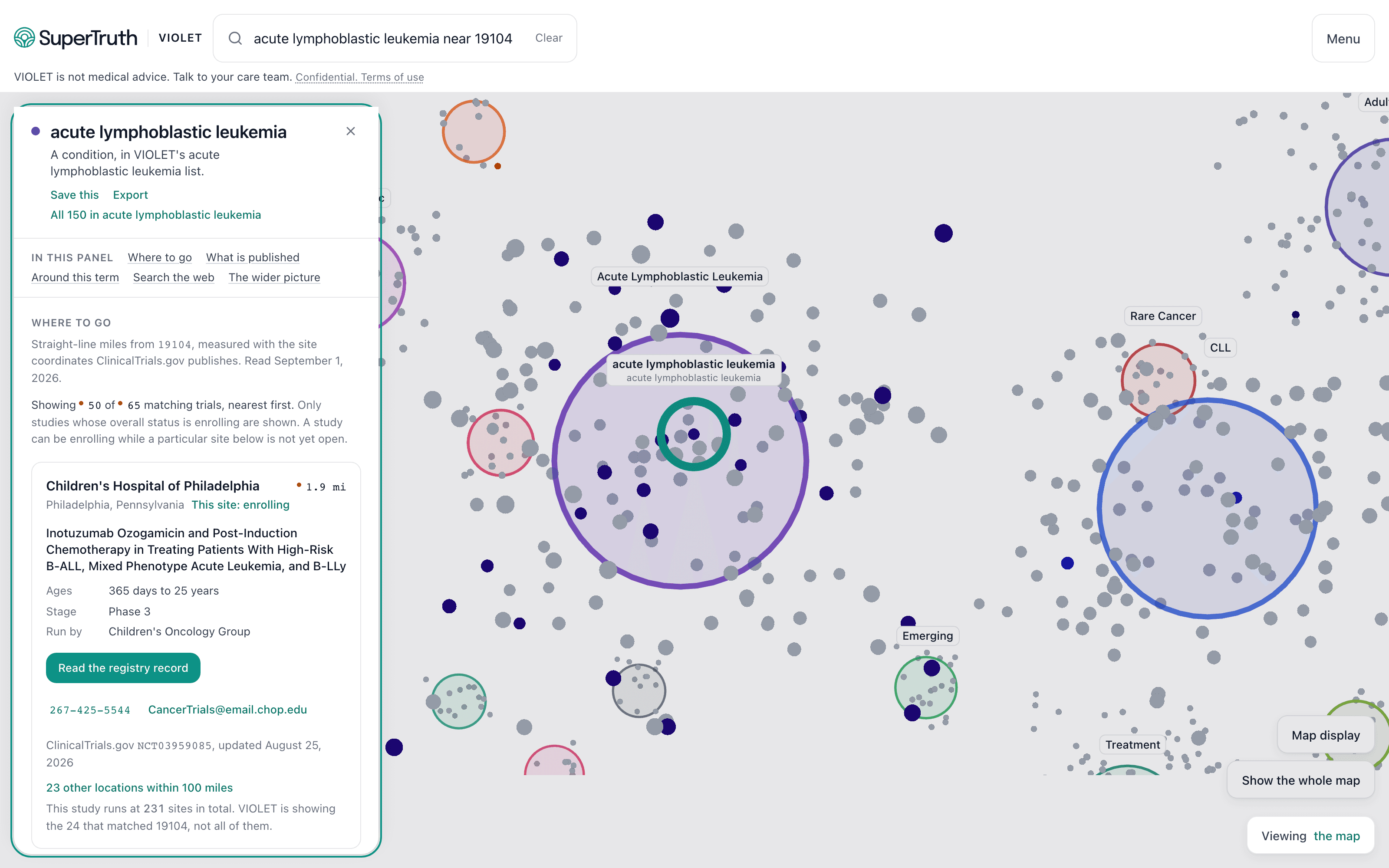
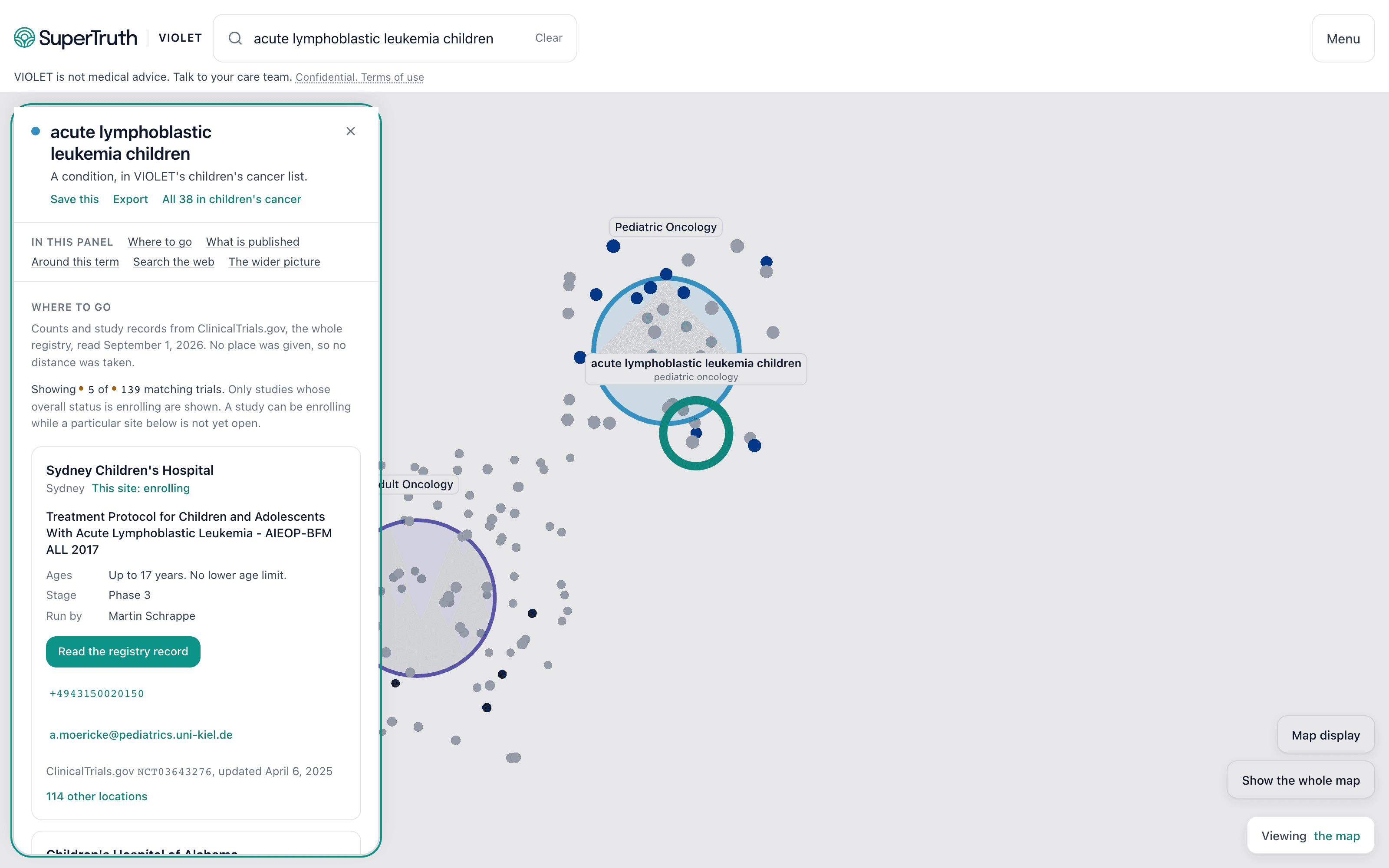
Visual Intelligence Layer for Oncology Trends and Evidence Triangulation. VIOLET finds what patients search before they ever see a doctor, and answers with the nearest enrolling trials, the evidence behind them, and a number to call. In live pediatric clinical use today, and the map carries adult oncology too. Every measured value carries its source and its date. The same engine can be commissioned for your disease area.
750+
Search terms mapped
6
Evidence sources
5yrs
Historical data
0
Searches retained
Oncology
For oncology centers, pharma and trial recruiters
A patient researching stage 3 treatment options at 2am is searching months before clinical presentation. VIOLET maps that search and answers with the nearest enrolling trials, the evidence behind them and a number to call. A family gets the answer in the first screenful; a trial recruiter scrolls the same sheet to see which cohorts are actively searching, not only which cohorts exist. Evidence is cross-checked across six sources (ClinicalTrials.gov, PubMed, FDA openFDA, Google Scholar, Google News, patents), and a gold mark means measured, from a named source, with a date. There is no patient record in VIOLET: it reads public evidence and aggregate search interest. A sign-in is logged; what you search is not, and that rule is enforced in the database schema.
Capabilities
What VIOLET does
The map and the sheet
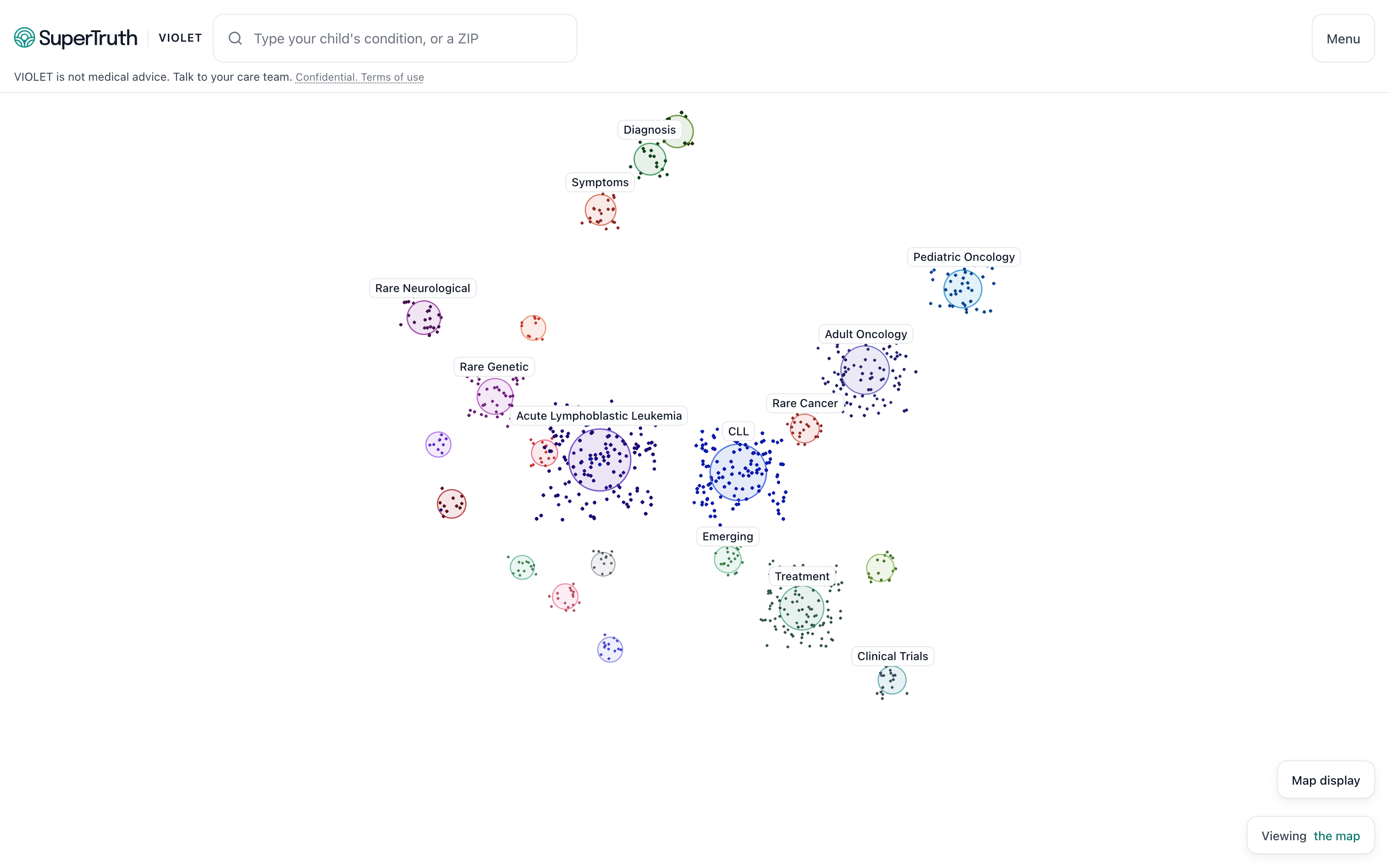
The ground is a map of the behavioral landscape. One sheet carries the answer: what this is, the nearest trials with a tappable number, the evidence, the context. A frightened parent gets it in the first screenful; an analyst scrolls the same sheet.
Provenance you can see
A gold mark means measured, from a named source, with a date. VIOLET's own derivations are said in words. Unknown is never rendered as zero.
Evidence triangulation
Six sources: ClinicalTrials.gov, PubMed, FDA openFDA, Google Scholar, Google News, Patents.
Trials, nearest first
Search scopes by ZIP, city, or hospital name against the registry's own spelling. Only a ZIP yields miles; a name narrows the list without inventing a distance.
Nothing about you is kept
Sign-in activity is logged. VIOLET does not record what you search. The guarantee is enforced in the database schema, not just promised.
A pipeline that checks itself
The corpus refreshes nightly, and an adversarial QA estate replays every known failure against production before anyone trusts the screen.
The engine points anywhere you aim it
Same machinery: a curated term taxonomy, six triangulated sources, nightly refresh, provenance on every value, a map and one answer sheet. Pediatric oncology proved it. It can be commissioned and stood up for your disease area.
Cancer data has a layer Google can see that clinicians cannot.
Before a patient steps into a waiting room, before they make an appointment, before they even know what they are looking for, they search. They search at 2am when the anxiety is highest. They search the name of the drug their oncologist mentioned. They search "stage 3 survival rate" and "clinical trials near me" and symptoms they are afraid to say out loud.
VIOLET maps that invisible layer.
The full name is the Visual Intelligence Layer for Oncology Trends and Evidence Triangulation. It is a behavioral signal intelligence platform in live clinical use: a map of how patients, caregivers, and advocates move through the information landscape of cancer, with one sheet that carries the answer. 750+ search terms. Curated clusters. Five years of historical data. Six evidence sources: ClinicalTrials.gov, PubMed, FDA openFDA, Google Scholar, Google News, and patents. Every measured value carries a named source and a date, and VIOLET does not record what you search.
The problem VIOLET solves is not a data shortage. The oncology space has more published research, more clinical trial data, and more genomic sequencing than any other field in medicine. The problem is that all of it is fragmented, inconsistent, and without a score to tell you what to believe before you act on it.
That is where the Data Trust Index™ connects. Every behavioral signal VIOLET surfaces is scored across SuperTruth's eight trust dimensions: Provenance, Consent, Recency, Quality, Concordance, Validation, Breadth, and Stability. The same cancer search term tracked across six independent evidence sources produces a higher DTI score than one tracked across two. The score travels with the signal permanently.
For pharma companies: VIOLET shows treatment awareness before campaigns launch, identifies the moment a drug name enters patient vocabulary, and surfaces rare disease cohorts actively searching for clinical trial options. The behavioral data runs months ahead of the clinical encounter.
For oncology centers: VIOLET shows what patient populations worry about after hours, where health equity gaps concentrate geographically, and which behavioral signals predict which care pathways. A hospital system in Philadelphia shows a different behavioral pattern than one in rural Appalachia.
For clinical trial recruiters: VIOLET finds motivated cohorts before those patients are lost to competing trials. A patient searching "stage 4 pancreatic cancer trial eligibility" at 2am is not browsing. They are deciding.
VIOLET is live in production. The semantic maps update continuously. Evidence triangulation runs across all six sources on a defined cadence. DTI scoring is applied to every signal before it surfaces.
SuperTruth's oncology work builds directly on the work for imaware, its diagnostics company: 105,000 diagnostic records standardized, analysis time cut from three weeks to two hours, a previously invisible customer segment identified as driving 20% of total revenue. The same infrastructure that made imaware's cancer diagnostic data trustworthy powers VIOLET.
The behavioral layer of cancer is not a separate problem from the data trust problem. They are the same problem. VIOLET is where those two problems converge.
Further reading
Who uses it
Built for the organizations that move health data
Families and clinicians navigating a child's new diagnosis
Oncology centers understanding patient journeys
Pharma companies tracking treatment awareness
Clinical trial recruiters finding motivated cohorts
Health equity researchers identifying gaps
Pharma, payers and research consortia commissioning the engine for their own disease area
What you get
The outcome, not just the capability
- Nearest trials with a number to call, and no record of what you search
- Answers with provenance attached
- Evidence triangulated across 6 sources
- Signals mapped across 750+ search terms
- Five years of history behind every trend
- A new intelligence layer, built for your subject on the same engine
See VIOLET in action
Schedule a 30-minute walkthrough with the SuperTruth team.